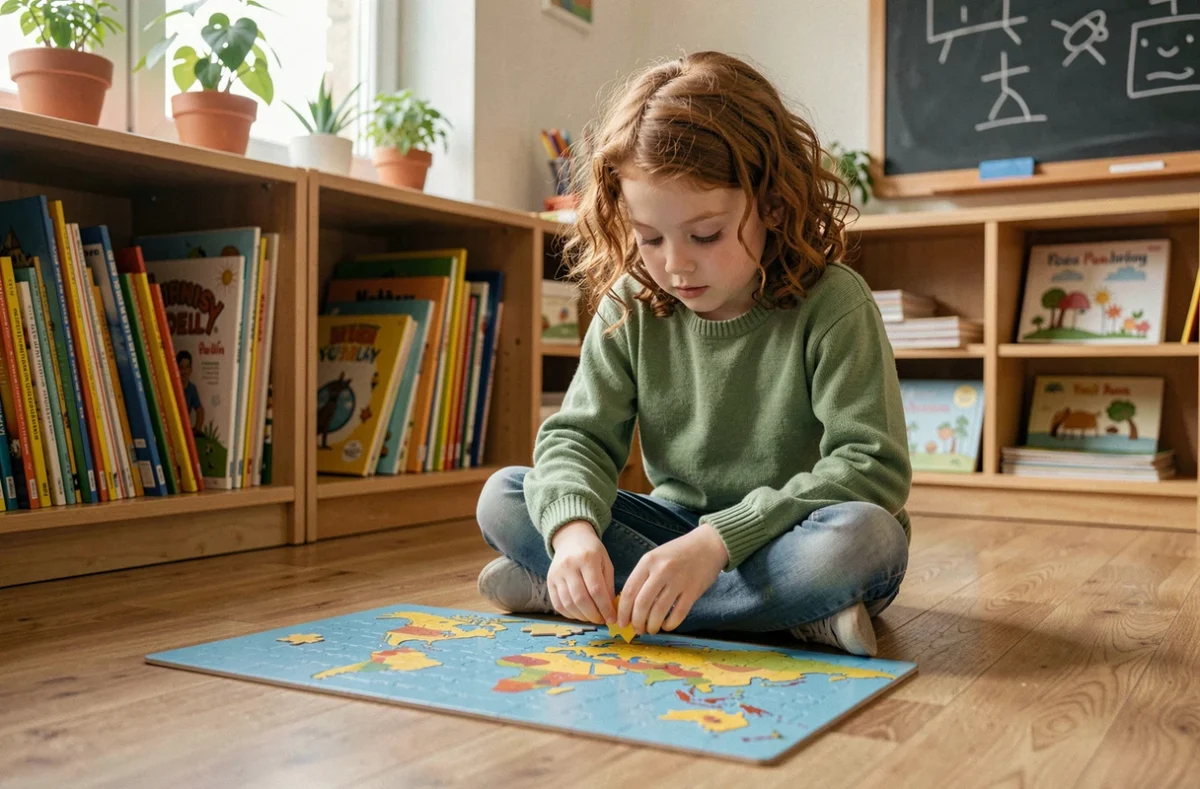
A four-year-old child stacking blocks to build a tower learns to anticipate balance, adjust fine motor skills, and manage frustration when everything collapses. This is not a trivial recreational moment: it is a comprehensive learning mechanism that simultaneously engages the body, logic, and emotions. Educational games leverage this mechanism by guiding exploration toward specific goals, without the child perceiving the effort as a school constraint.
Adult Support and Educational Play: The Dosage That Changes Everything
It is often assumed that simply placing a game in front of a child will trigger learning. In practice, preschool programs that produce lasting results combine child-led exploration with intentional adult support. The adult does not direct the play but asks questions, prompts reflection, and articulates what the child is experiencing.
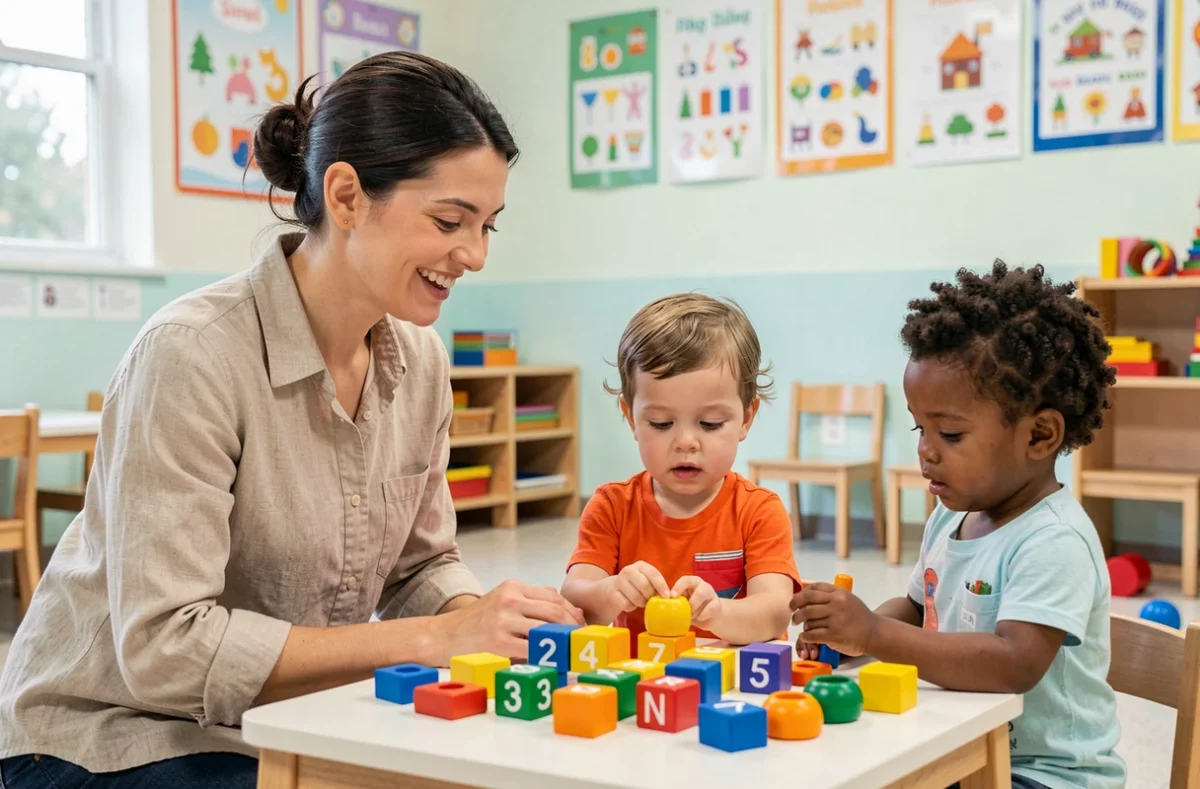
When a child sorts geometric shapes, a parent or educator can name the shape, ask why it doesn’t fit in a certain spot, or suggest counting the remaining pieces. This light guidance transforms a manipulation activity into an exercise in language, logic, and numeracy.
This detailed approach is found in an article that explores the importance of educational games on Greg From Paris, where the role of the adult as a mediator of play is put into perspective with the concrete benefits for cognitive development.
The trap is the opposite excess: an adult who corrects every action or imposes a rigid procedure breaks the exploratory dynamic. The child learns better when they maintain the initiative of the play, with an adult available to enrich the experience, not to control it.
Motor Skills, Language, Social Rules: What Each Type of Educational Game Targets
Not all educational games work on the same skills. We become more effective when we identify which area of development a game addresses, rather than accumulating activities randomly.
Construction Games and Fine Motor Skills
Stacking, screwing, fitting together: these repeated actions strengthen hand-eye coordination and prepare for writing. A child manipulating puzzle pieces also works on their concentration and ability to solve problems through trial and error.
Role-Playing Games and Social Skills
Playing shopkeeper, doctor, or chef encourages the child to put themselves in someone else’s shoes, negotiate a scenario with peers, and express their emotions through language rather than gestures. This type of play develops empathy and conflict management long before the child can name these skills.
Board Games and Respect for Rules
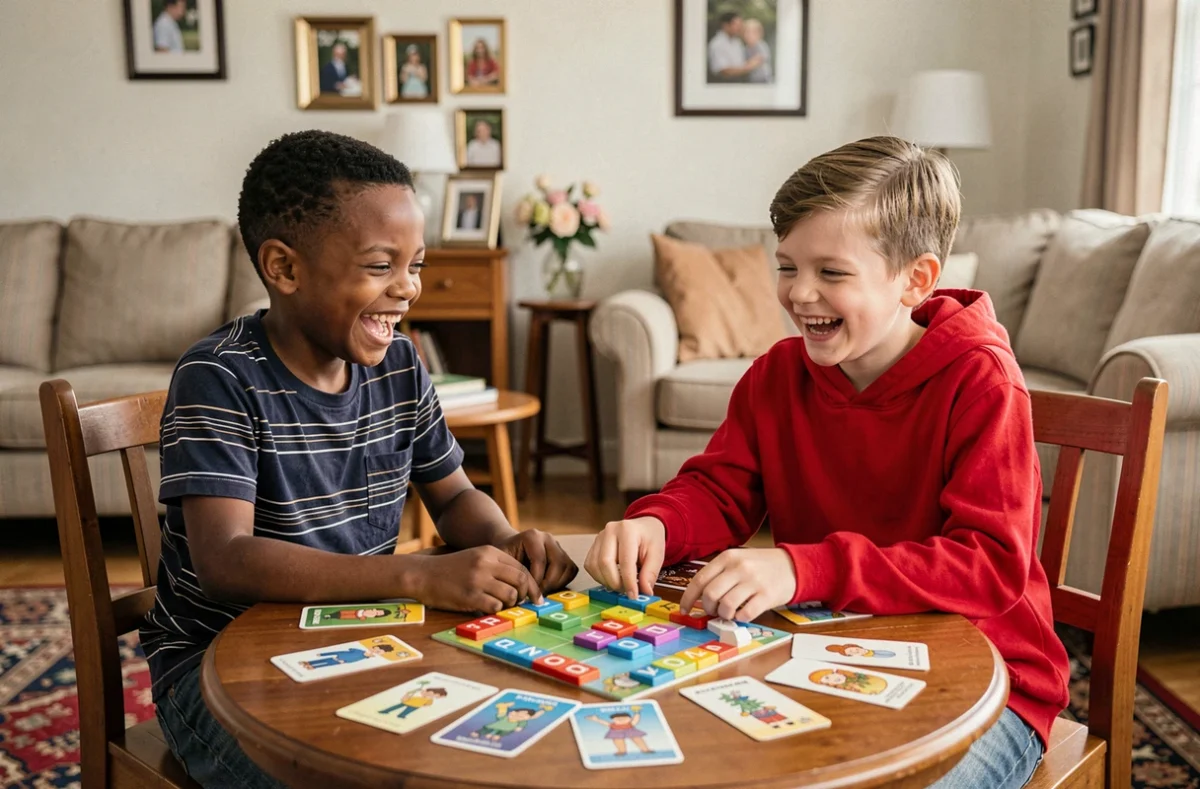
Waiting for their turn, accepting to lose, counting points: board games with rules structure the relationship to the group. They introduce abstract concepts (sequence, chance, strategy) in a motivating framework. For children aged five or six and up, these games are a real lever for learning to respect a collective framework.
- Sorting and classification games (shapes, colors, sizes) engage logic and descriptive vocabulary from the age of two or three.
- Cooperative games, where players win together against the board, reduce competition and promote mutual assistance among children of different ages.
- Letter and sound games (phonetic bingo, magnetic alphabets) prepare for reading by associating a sound with a visual symbol.
Continuity of Learning: Why an Isolated Game is Not Enough
A research report shared by the Gates Foundation emphasizes that the continuity of learning experiences is as important as the activity itself. Coherent educational pathways from preschool to the early years of primary school help consolidate skills in language and literacy. Conversely, discontinuous experiences risk eroding acquired skills.
In practical terms, this means that one cannot rely solely on an occasional educational game on Wednesday afternoons. Integrating educational play into daily life, at home as well as in class, produces more solid effects than an isolated session, no matter how well designed it is.
In France, preschool programs reinforce objectives in language and early mathematical tools while maintaining a focus on manipulation and exploration. Play is not a recreational supplement in this context: it is part of the official educational framework.
Educational Digital Games for Children: What We Know and What Remains Unclear
Applications and tablets labeled “educational” are multiplying. Some offer interesting mechanics: immediate feedback, adaptation to the child’s level, visual and auditory stimulation. For targeted skills such as letter recognition or simple calculations, positive short-term effects have been documented.
Long-term benefits remain less clear. A recent review on digital play-based learning in early childhood notes that research still lacks long-term data on the sustainability of acquired skills. The heterogeneity of studies, differences in protocols, and the variety of tested applications limit causal conclusions.
What varies from one application to another is primarily the quality of the educational design. An application that merely rewards quick clicks does not have the same effect as a digital game that encourages reflection and allows time for exploration. The medium (screen or board) matters less than the game mechanics and the presence of an adult to extend the exchange.
- Favor applications that offer a tiered progression rather than mechanical repetition.
- Limit screen time and alternate with physical games to maintain a variety of sensory stimulation.
- Play with the child on the application, at least the first few times, to turn the screen into a dialogue support.
Educational play, whether in the form of a wooden puzzle, a cooperative board game, or a well-designed application, remains a learning tool whose effectiveness depends on its context of use. An attentive adult, regular practice, and a choice appropriate to the child’s age make more of a difference than the game itself.