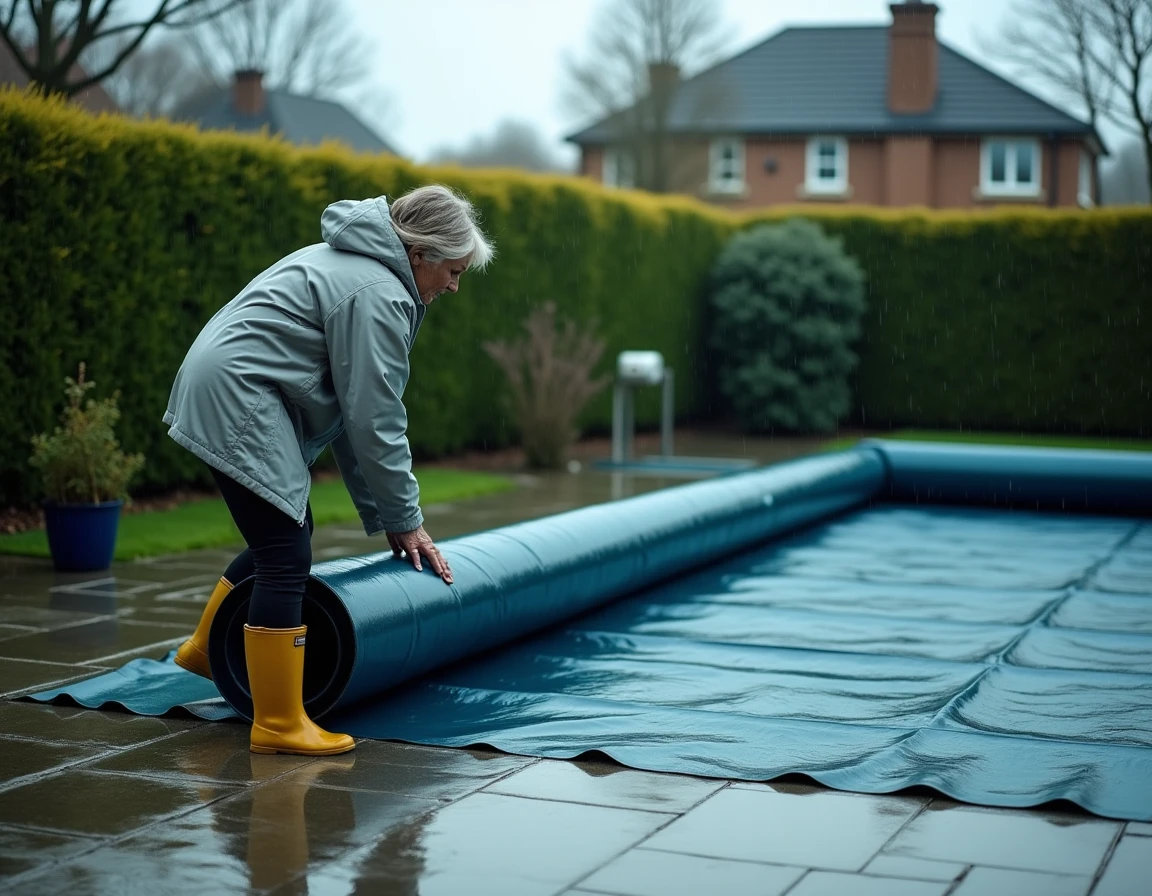
After three days of continuous rain, we often find the same scenario: a cover sagging under the weight of the water, a pH that has dropped, leaves everywhere in the pool, and a pump making a suspicious noise. The reflex to cover your pool before the downpour is good, but if done poorly, it can sometimes cause more damage than the rain itself.
Pool cover in the rain: avoid it becoming a trap
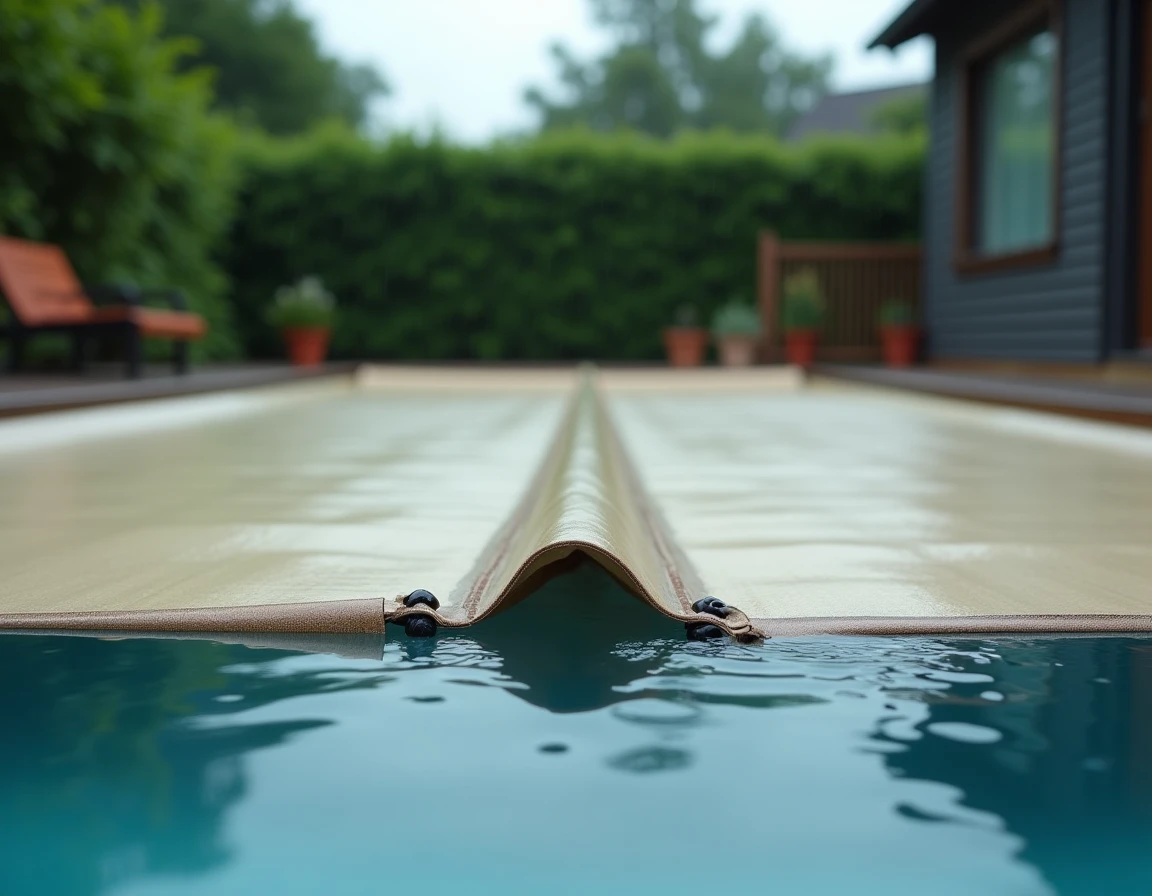
The most common problem is not the rain falling into the pool, it’s the water that stagnates on the cover. A winter cover or a safety cover quickly accumulates several hundred liters in the center. This pocket of water pulls on the fastenings, distorts the fabric, and can tear off the bungee cords or the anchors sealed into the coping.
It is often recommended to stretch the cover as much as possible to avoid this phenomenon. This is a mistake. The tension of the bungee cord acts as a safety valve: it allows the cover to sag slightly when water accumulates in the center, which limits the risks of deformation or tearing. A cover that is too rigid bears the entire load without flexibility.
As detailed in Murmures Déco’s practical articles, the best practice is to regularly remove stagnant water with a submersible pump or simply a suitable broom, rather than relying solely on the tension of the cover.
Another often overlooked point: check the condition of the eyelets and straps before each forecasted rain episode. A rusty eyelet or a frayed strap is a breaking point that can fail at the worst moment.
Protecting the pool pump from moisture and infiltration
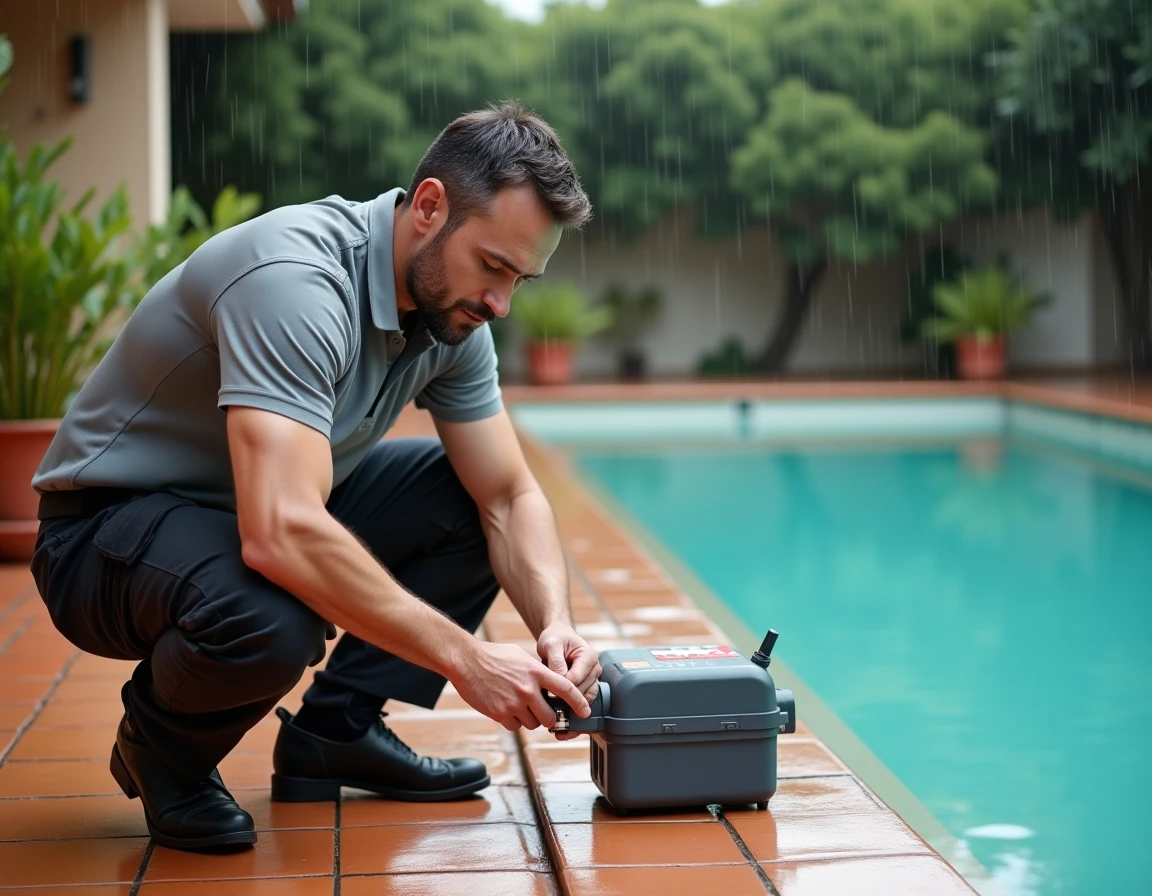
Protection from rain is not limited to the pool. The technical room is a vulnerable area that many owners forget. A pool pump exposed to water splashes or installed in a poorly ventilated room can fail due to short-circuiting or corrosion of electrical components.
Specifically, we check three things before a heavy rain episode:
- Is the technical room watertight at the bottom, where runoff water can seep in through the door threshold or pipe passages?
- Is the pump elevated above the floor of the room, even by a few centimeters, to prevent a puddle from touching the motor?
- Are the electrical connections protected by a watertight box that meets standards, and is the residual current circuit breaker functional?
A flooded pump after a storm costs much more than a preventive elevation. A simple support made of concrete blocks or a PVC shelf is sufficient in most configurations.
Water quality after rain: actions to prevent green water
Rain is naturally acidic. A prolonged episode dilutes the disinfectant present in the pool (chlorine or bromine), lowers the pH, and decreases the TAC (total alkalinity). The result: the water loses its buffering capacity, and algae take advantage of this imbalance to develop within hours.
You don’t correct everything at once. Order matters.
- First, restore the TAC if it has dropped too low. Without sufficient TAC, the pH will remain unstable no matter what you do.
- Next, adjust the pH to the range suitable for the treatment used (lower for chlorine, slightly higher for bromine).
- Finally, raise the disinfectant level. A shock treatment may be necessary if the water has already turned or if the rain lasted several days.
Treating out of order is a waste of product: a shock chlorine in water with too low a pH loses much of its effectiveness.
Extended filtration after the rain episode
Increase the filtration time by a few hours the day after the rain. The skimmers will have sucked up plant debris, dirt, and sometimes sand. You need to empty the skimmer baskets and clean the filter (backwash for a sand filter, rinse for a cartridge) before restarting a long cycle.
Opinions vary on the additional filtration duration needed, as it depends on the pool volume and the intensity of the rain. In practice, it is observed that an extended filtration cycle of one-third to half of the usual duration is sufficient to restore clear water.
Pool water level: managing overflow without panic
A pool overflowing after heavy rains is common. The real risk is not aesthetic: too high a water level prevents the skimmers from functioning properly. Surface skimming no longer occurs, pollutants remain in the pool, and filtration runs for nothing.
The simplest solution is to set the multiport valve to drain (or “sewer”) to evacuate the excess to the stormwater network. You can also take advantage of this surplus to perform a backwash of the filter, which serves two purposes.
Cover or not during the downpour
Should you cover the pool during the rain? If you have a rigid pool shelter (like a sliding veranda), the question does not arise: you close it. For a soft cover or a rolling shutter, the answer is less clear-cut. Covering protects from debris and limits dilution, but you encounter the problem of water accumulation on the cover.
A rolling shutter handles the load better than a safety cover, thanks to its rigid slats. For a bubble cover, it’s better to remove it before heavy rain: it is not designed to support a significant weight of water and risks tearing.
The choice therefore depends on the type of cover installed. Protecting your pool from rain starts with knowing the limits of your own equipment, not by applying a one-size-fits-all recipe to all pools.